
Disclosure: I’m the founder of Bubblin, which makes Superbooks.
I can ask a classmate to turn to page 510 of Pride and Prejudice. If we have the same edition, we know where to look. We can spend our time discussing Elizabeth and Darcy rather than trying to find each other in the text.
That is one of the best things about physical books: referential accessibility. A page number gives us a shared place to look.
You don’t notice the convenience until the pages start moving.
When the pages move
In a reflowable e-book, the text flows into whatever space the reader’s device provides. Change the screen size, font, or reading settings, and the page breaks can move.
That flexibility is useful. It also means my page 510 may contain something different from yours. Even my own phone and tablet can divide the same book differently.
I can’t know where your page breaks fall. “Turn to page 510” stops working as an instruction.
This is a real problem for shared reading. Teachers need to direct a class to a passage. Readers need to cite it, discuss it, and return to it later. Calling a layout fluid does not make those needs disappear.
Digital books can provide stable references. EPUB, for example, has Canonical Fragment Identifiers that identify locations within a publication. A link to a paragraph can solve the problem of finding that paragraph.
I wanted to preserve something else as well: the page as a shared unit of reading. A class can discuss its opening paragraph, an illustration and its caption, or the relationship between two passages on that page. Everyone has the same group of material in front of them, with a familiar number they can say aloud.
That is the argument for keeping a page’s identity. Its dimensions can change while the content assigned to it stays together. It gives readers a common frame for discussing the book, even when they use different screens.

Fixed-layout e-books keep the page boundaries, but a page designed for one screen is awkward on another, and those layouts take work to produce and maintain.
I wanted the page to keep its identity while adapting to the screen.
Strong layouts
A strong layout was our attempt to get the best of fluid and fixed layouts in Superbooks.
The content assigned to a page stays together. The layout scales to the available space while preserving the proportions and relative positions of its parts. Text, images, and other elements should retain their visual balance as the page grows or shrinks.
A bit like Spandex.
The aim was a page that keeps its identity while its presentation adapts. That also means dealing with what happens when a reader enlarges the text. Shrinking the whole page until it fits can make the words too small to read.
If larger text overflows, the reader needs a way to reach all of it while keeping the page reference meaningful. Preserving the reference should not require the reader to accept an uncomfortable font size. That is a requirement the layout and reading interface have to meet together.
One useful result of that approach was a page number we could put directly in the URL.
A page with an address
The archived screenshot of the Superbook edition of Pride and Prejudice shows page 510 at its own address: https://bubblin.io/book/pride-and-prejudice-by-jane-austen/510. The number at the end of the URL matches the page number in the reader.
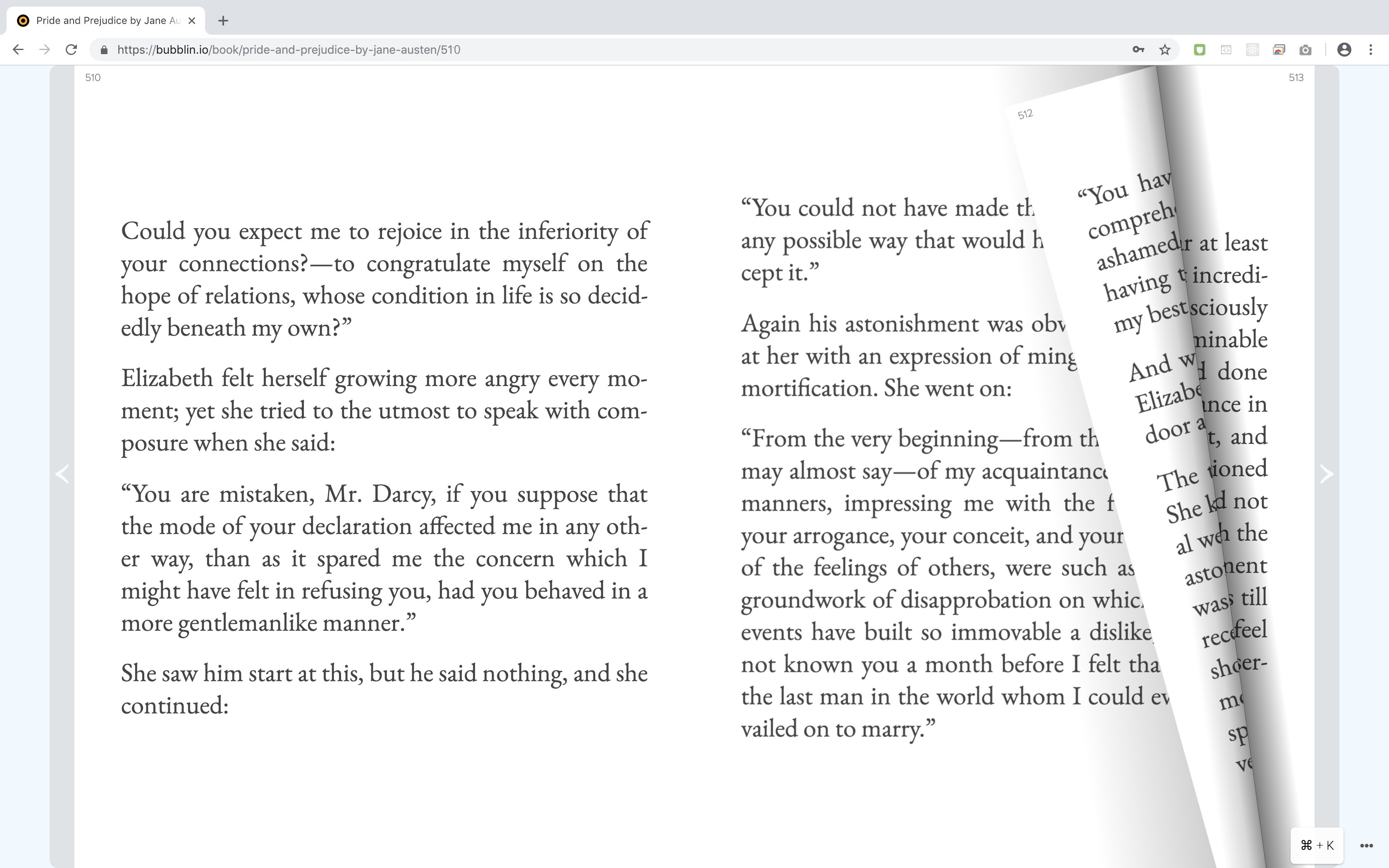
/510 at the end of its address.As you move through the book, the address changes with the page. You can copy it, send it to someone, or return to it later.
For a given edition, readers should find the same content at the same page address, even when they open it on different devices. The browser becomes the reader, and the link becomes the reference. No special reading device is needed.
When I send a classmate that address, we can discuss the opening paragraph or the passage at the bottom of the same page. Our screens can differ while the reference and the material it identifies stay the same.